What the Water Knows
The colors are still finding their shape.

While Oliver was alive, I painted in the basement.
He and I shared a small workshop room down there, and the workbench against the far wall was painted lavender. The previous owners had left it behind, dingy and unapproachable, and I had painted it. The lavender made it feel like a dream of painting that had laid dormant for years, opening up again like an invitation. We both loved that lavender workbench, and we both loved working in that room. He worked in sawdust and leather shards and small bright bits of metal, and I worked in pigment and water and clean brushes laid out in a row. We jockeyed for that one surface in the most loving way two people can jockey for anything. He would go down and use the bench and leave it the way he left it, and I would come down later and clean it before I could begin, careful not to let any of his materials find their way into my paint. Then I would work, and then he would come back, and the negotiation would begin again.
That is where I painted the first cards of the deck.
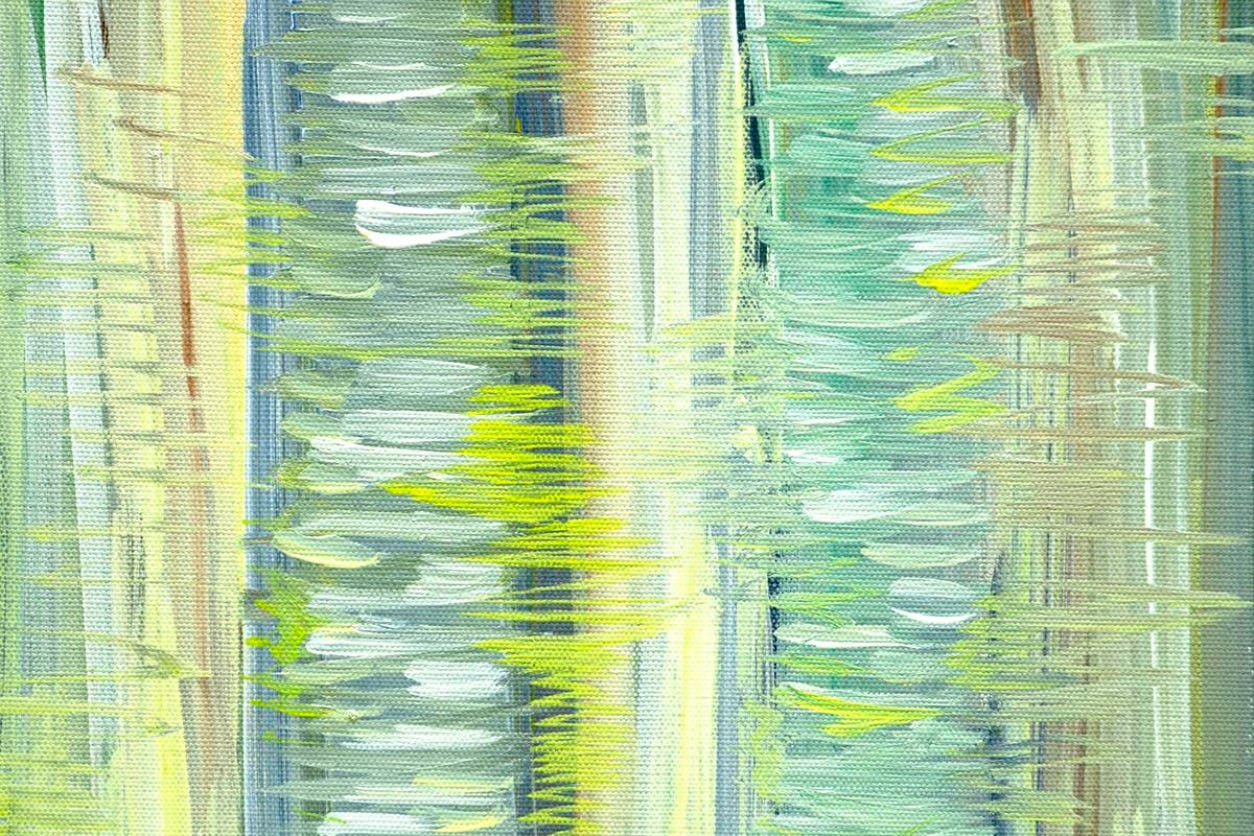
I had started an oracle deck in the in-between, the suspended season when we thought he was in remission and the future seemed to be opening back up. Seventy-two cards were made from one-foot-square acrylic paintings, and each one was a visual translation of how a particular plant medicine moved through my body. For me, this was a kind of synesthesia, where color was feeling and pigment was the language my body used when words would not come.
I would carry the one-foot-square works in progress upstairs and into Oliver’s room to show him. He saw five or six of them before the cancer came back. The photo of him, taken the morning he first began high school after completing his chemotherapy treatment, is in the deck now, and the deck is dedicated to him
Birch, his favorite essential oil, the oil of community.
I painted in acrylic in those months because acrylic is forgiving. You can layer over what you got wrong. You can wait a day and come back and cover it. The medium does not punish you for not knowing. I needed that then. I did not have the stillness yet for anything more delicate, and oil was too fussy, too slow, and too demanding of decisions I could not yet make. Acrylic let me move color around the canvas without being asked to be sure of anything. Moving color around was how I let the feeling out of my body. It was how I stayed in the room with what was happening.
About a year after he crossed, I opened a small studio in town, near a brook. I went there to finish the cards he had not lived to see. A blue heron used to come while I painted. He would fly down and settle on a rock just outside the studio window, and he would stay there sometimes for an hour. I came to feel that he was carrying something for me: a message, or a presence, or simply a witness. He is still there now, in the part of me that remembers what it was to be held by something I could not name.
Painting with watercolor came later. It came because I wanted to work small, in journals, or in books a person could carry in a bag, or on paper that did not require a stretcher, or a wall, or a year of training to approach. I wanted to use materials that a newly grieving person could pick up without flinching. I wanted to use paint in a way that someone who had never picked up a brush, whose hands were shaking with grief, and who needed a place to put their feelings, could just simply begin. So I began learning watercolor, and watercolor, as it turns out, is a different kind of teacher than acrylic was.
Watercolor is not a medium that rewards control. You can hold the brush, you can choose the pigment, you can prepare the paper, and still the water will do what the water wants. It will bloom where you did not plan for it to bloom. It will carry the color into places you did not intend for it to go. It will dry differently than it looked when it was wet, and by the time you see what the painting is actually going to be, the moment to change it has usually passed.
I love to use a technique called wet into wet. You lay down water first, then you drop the paint into it, and you let the two find each other. You cannot rush it. You cannot tidy it. If you touch it too soon the whole thing muddies. If you wait too long the edge hardens into a line you did not want. There is a window, and the window is narrow, and inside the window the only thing to do is watch.
Most of what grief has asked of me is the same thing. Watch. Do not rush it. Do not tidy it. Wait for the edge to tell you what it wants to be.
I work in Oliver’s room now. I converted it into a makerspace, and I paint there with watercolor in a handmade notebook and a handmade workbook that I have created for the members of the Creative Cocoon community. Last week my hands were stained in shades of Payne’s gray and Robin’s egg blue, and they looked the way his hands used to look after hours spent creating in this same room.
I am not sure if watercolor specifically, or painting in general, is helping me to accept the loss. I do know that it is making it easier for me to move forward.
I know it is teaching me to be present with what the water is doing, which is the only place any of us actually ever lives. We live inside the bloom, inside the spreading, inside the moment where the colors are still finding their shape and no amount of grip will hurry them home.
I pick up the brush, and I wet the paper, and I begin. And somewhere in me I am still that woman at the lavender workbench, listening for his footsteps on the basement stairs, painting canvases for a son who was still here to see them.